


Rory
Intro
Cigarettes were some of the most consistently advertised products in every year in the archive. The display of the packs barely changed decade to decade, but the message certainly did. From luxury to health, economy, identity, safety, and aspiration. I’ve pulled out some of my best samples from the decades to see how the history of cigarette advertising has changed from the 1920s to the 1980s.
1920s: Luxury and Lifestyle
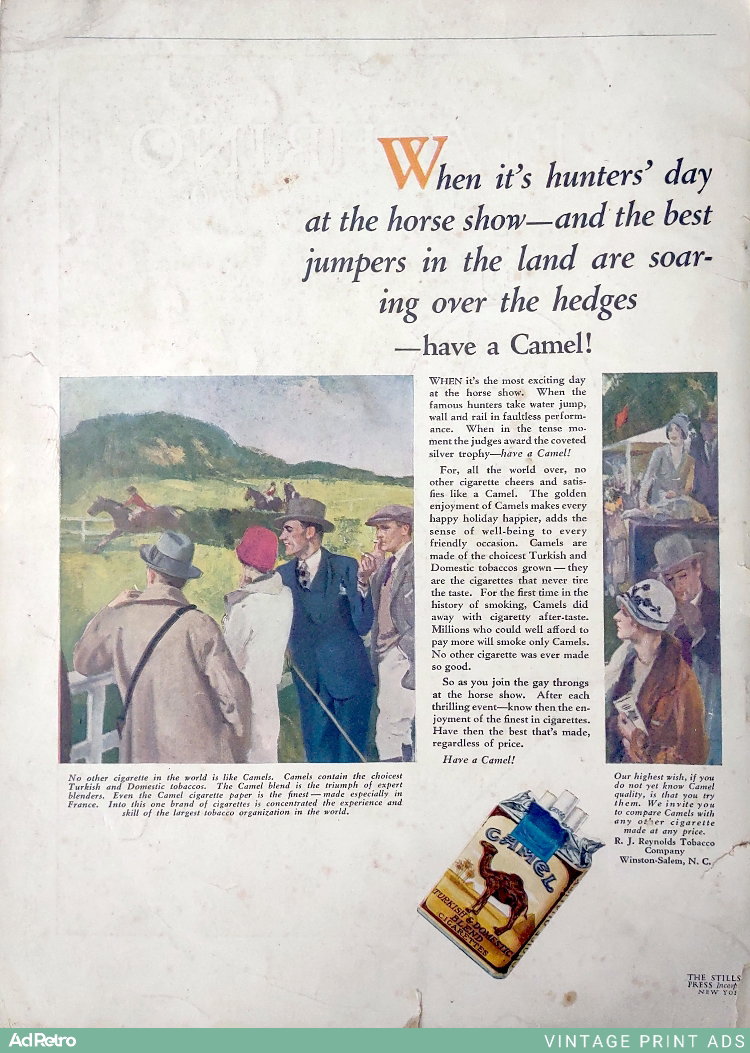
Camel, “When it's hunters' day at the horse show—and the best jumpers in the land are soaring over the hedges—have a Camel!”, International Studio, 1926. In the archive.
The copy places Camel in a society crowd at a horse show and sells it as “the best that's made, regardless of price.” “Millions who could well afford to pay more,” it says, “will smoke only Camels.”
The earliest cigarette advertising in my collection portrayed their smokers as upper class and high society.
1930s: Healthy Smoking
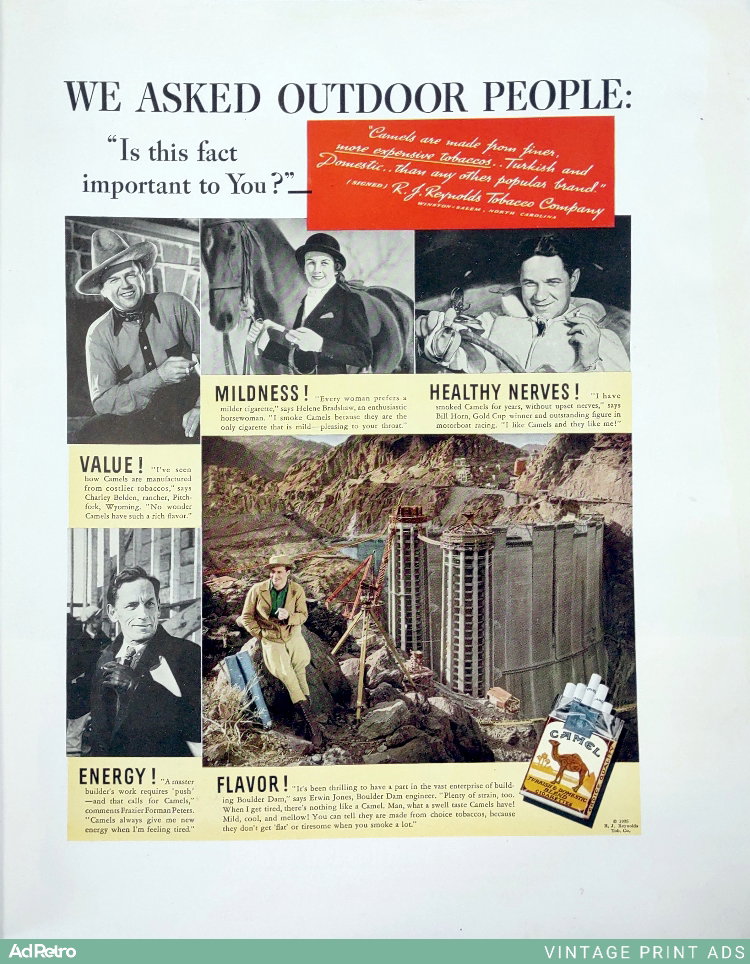
Camel, “We Asked Outdoor People: ‘Is this fact important to You?’”, Fortune, 1935. In the archive.
The page is built around testimonials, including a Boulder Dam engineer, and it does not shy away from health language. One panel is headed “HEALTHY NERVES!”; another, “ENERGY!”, quotes a “master builder” who says, “Camels always give me new energy when I'm feeling tired.”
The 1930s were a decade of new industrial foods and health trends, and cigarettes took their place in these trends. Simple staple foods were given extraordinary benefits, claims that would not be allowed today.
1940s: Economy and Value
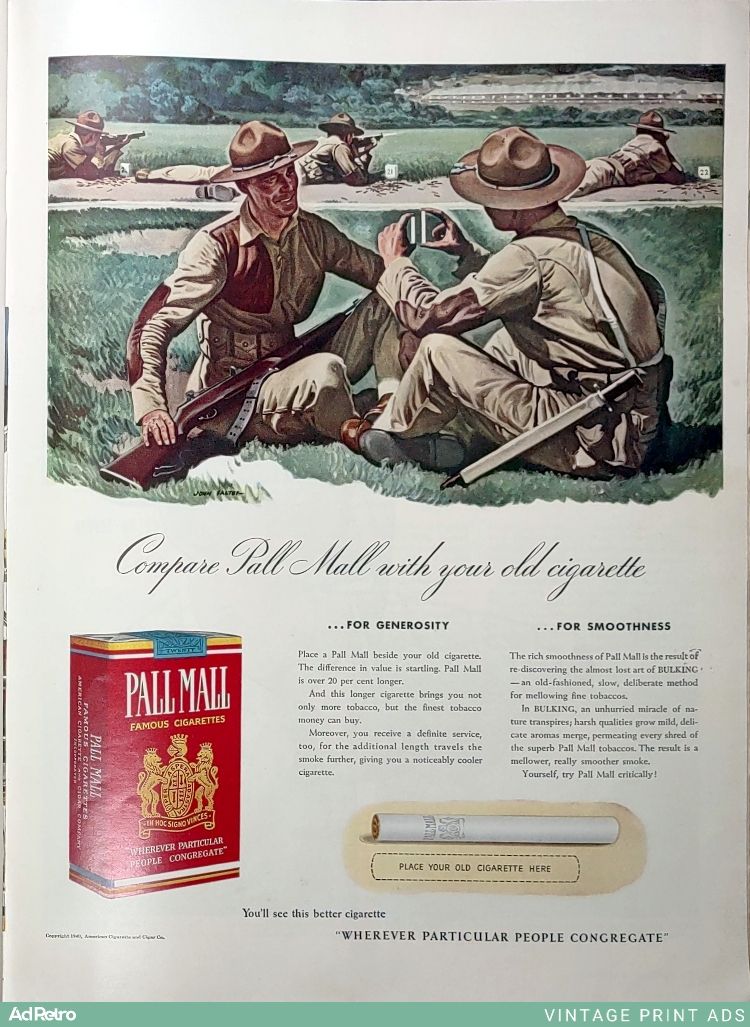
Pall Mall, “Compare Pall Mall with your old cigarette”, Life, October 7, 1940. In the archive.
Under the heading “…FOR GENEROSITY,” the ad makes a straight value claim: “The difference in value is startling. Pall Mall is over 20 per cent longer.” That longer cigarette, it says, “brings you not only more tobacco, but the finest tobacco money can buy.”
As advertising moved into the early 1940s, a lot of the copy was related to the military and the economy. This ad is a good example of both. It includes both men in military uniform and the 20% “longer” value claim. This is also one of my favorite ads for its subtle gay undertones.
1950s: Filtered Taste
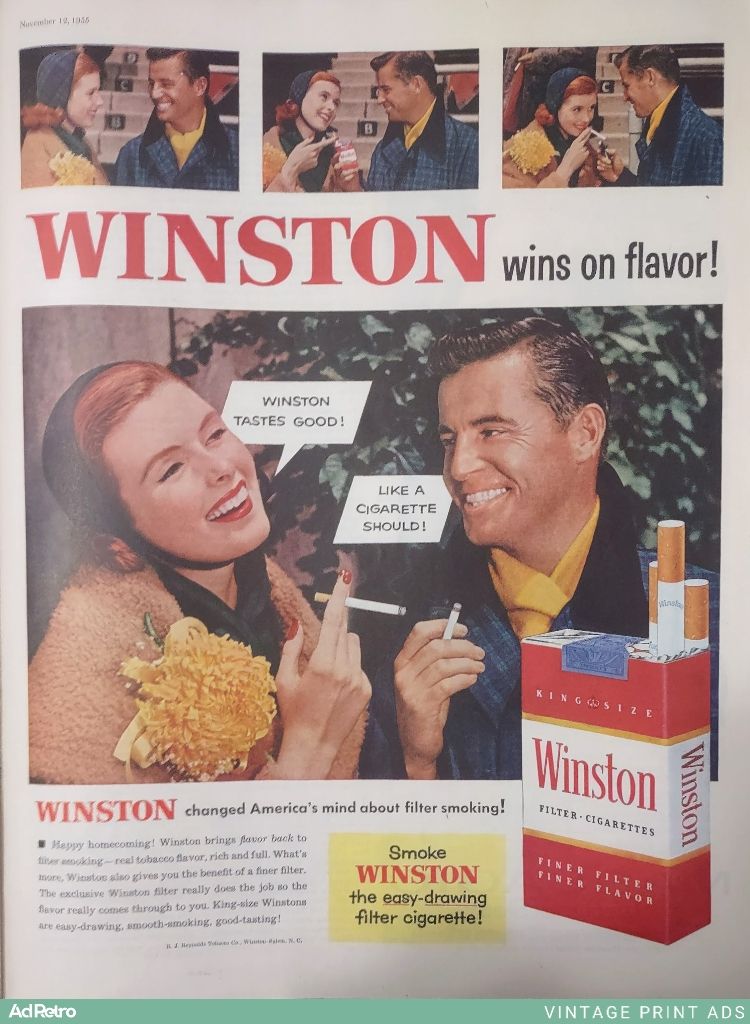
Winston, “Winston wins on flavor!”, The Saturday Evening Post, November 12, 1955. In the archive.
The pitch is flavor through a filter. Speech balloons spell out the famous line, “Winston tastes good!” / “Like a cigarette should!”, and the subhead claims “Winston changed America’s mind about filter smoking!” The copy says Winston “brings flavor back to filter smoking—real tobacco flavor, rich and full,” and a yellow box sells it as “the easy-drawing filter cigarette.”
A big theme that repeats in the 50s is the use of filters while still maintaining a great taste. At this time, perhaps the health impacts were becoming better known.
1960s: Smoking as Identity
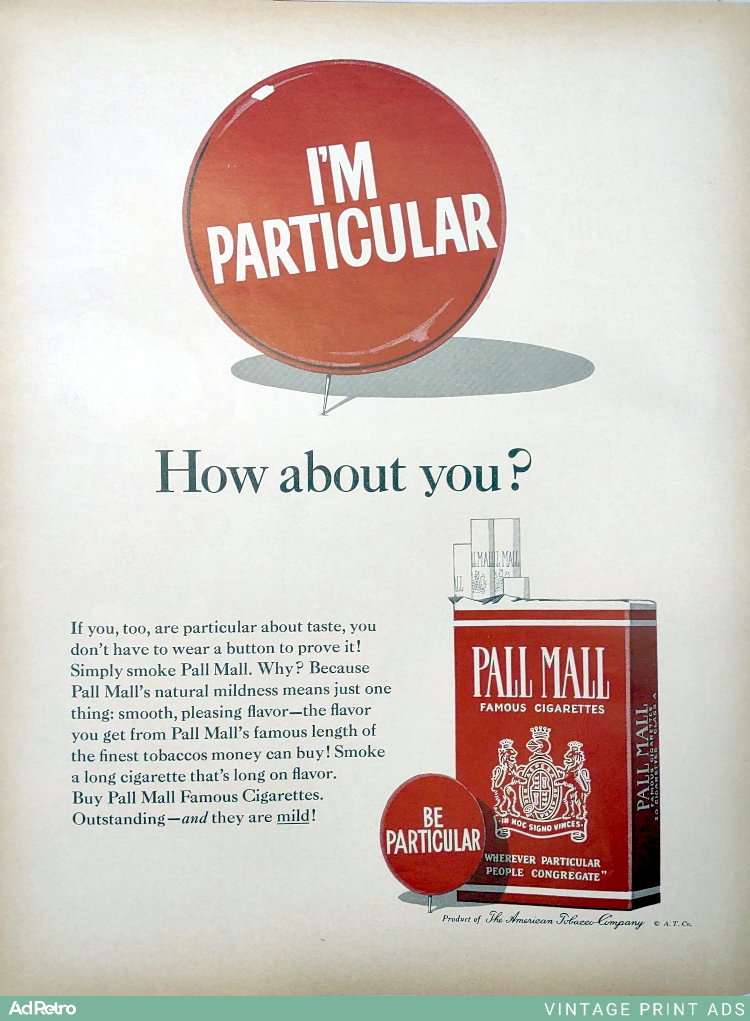
Pall Mall, “I'm Particular. How about you?”, Life, January 8, 1965. In the archive.
The red button is the ad. “If you, too, are particular about taste,” the copy says, “you don't have to wear a button to prove it! Simply smoke Pall Mall.” The pack still carries the older line, “Wherever particular people congregate.”
The 60s are the first decade of what I consider “modern” advertising, and the cigarette ads took a sharp turn from product-focused to buyer identity. This ad was the epitome of identity: a Pall Mall smoker is “Particular.”
1970s: Low Tar & Taste

True, “Unexpected taste at only 5 mg tar”, Life, October 1978. In the archive.
The whole page is the number 5. Regular and menthol packs both promise “5 mgs. tar, 0.4 mg. nicotine,” citing the FTC report of May 1978, and the headline is built to hold two ideas at once: very low tar, and “unexpected taste.”
Many ads from this period mentioned their low tar content while maintaining “great taste.” They were attempting to address health concerns and respond to government testing of tar levels.
1980s: Aspiration
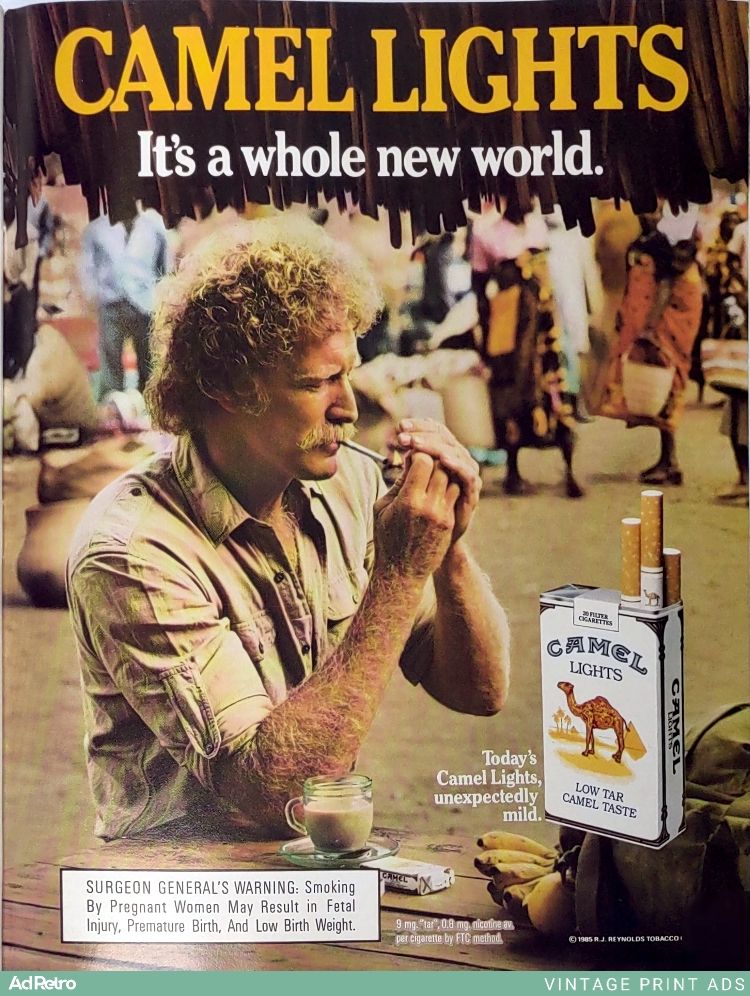
Camel Lights, “It's a whole new world.”, Omni, January 1986. In the archive.
A man smokes at a market stall, coffee at his elbow, while the pack promises “Low Tar Camel Taste.” The line under the pack is “Today's Camel Lights, unexpectedly mild.” The ad is copyrighted 1985; this appearance is in a 1986 issue of Omni.
The 80s cigarette advertisers turned away from the extreme health consciousness back to more of an identity focus. Ads in this period evoke the aspirational character or lifestyle of the smoker.
The warning labels
The earlier ads in this set have no health warning at all. By the 1978 True ad, a small box at the bottom carries the general line then required on cigarette advertising: “Warning: The Surgeon General Has Determined That Cigarette Smoking Is Dangerous to Your Health.” That wording was required on packs under the Public Health Cigarette Smoking Act of 1969, and it was later required on print advertising as well.
The 1986 Camel Lights ad has a different warning: “SURGEON GENERAL'S WARNING: Smoking By Pregnant Women May Result in Fetal Injury, Premature Birth, And Low Birth Weight.” That is one of four rotating warnings required on packages and advertisements by the Comprehensive Smoking Education Act of 1984.
The Surgeon General’s warning unfortunately breaks the composition and ruins a lot of the visual appeal of the cigarette advertisements for me from the 70s onward.
More from the archive
The pitch kept changing. The product, for the most part, did not.
See more in the  Vintage Cigarette Ads, and in the decade hubs:
 1920s Vintage Ads, 1930s Vintage Ads, 1940s Vintage Ads, 1950s Vintage Ads, 1960s Vintage Ads, 1970s Vintage Ads, and 1980s Vintage Ads.
[Suggested citation:] Rory Laitila, Vintage Cigarette Ads: How Tobacco Advertising Changed from the 1920s to 1980s, AdRetro, 2026, https://adretro.com/posts/vintage-cigarette-ads-how-tobacco-advertising-changed-from-the-1920s-to-1980s



New finds and commentary from the archive, posted regularly.

Get notified about new ads and changes to the collection.

An archive of real vintage print ads, photographed from original magazines from the 1910s to the 1980s. Quirky, gay, fashion, tech and everyday ads from famous and not so famous magazines.
Ad Collections
The vintage advertisements shown on AdRetro are historical materials, presented for archival, educational and commentary purposes. All brands, trademarks and original artwork belong to their respective owners, and AdRetro claims no ownership of them. The photographs, scans, restorations and descriptions on this site are AdRetro's own work and may not be reused without permission. If you believe something here infringes your rights, please submit a copyright complaint and we'll respond quickly. See our Terms and Conditions